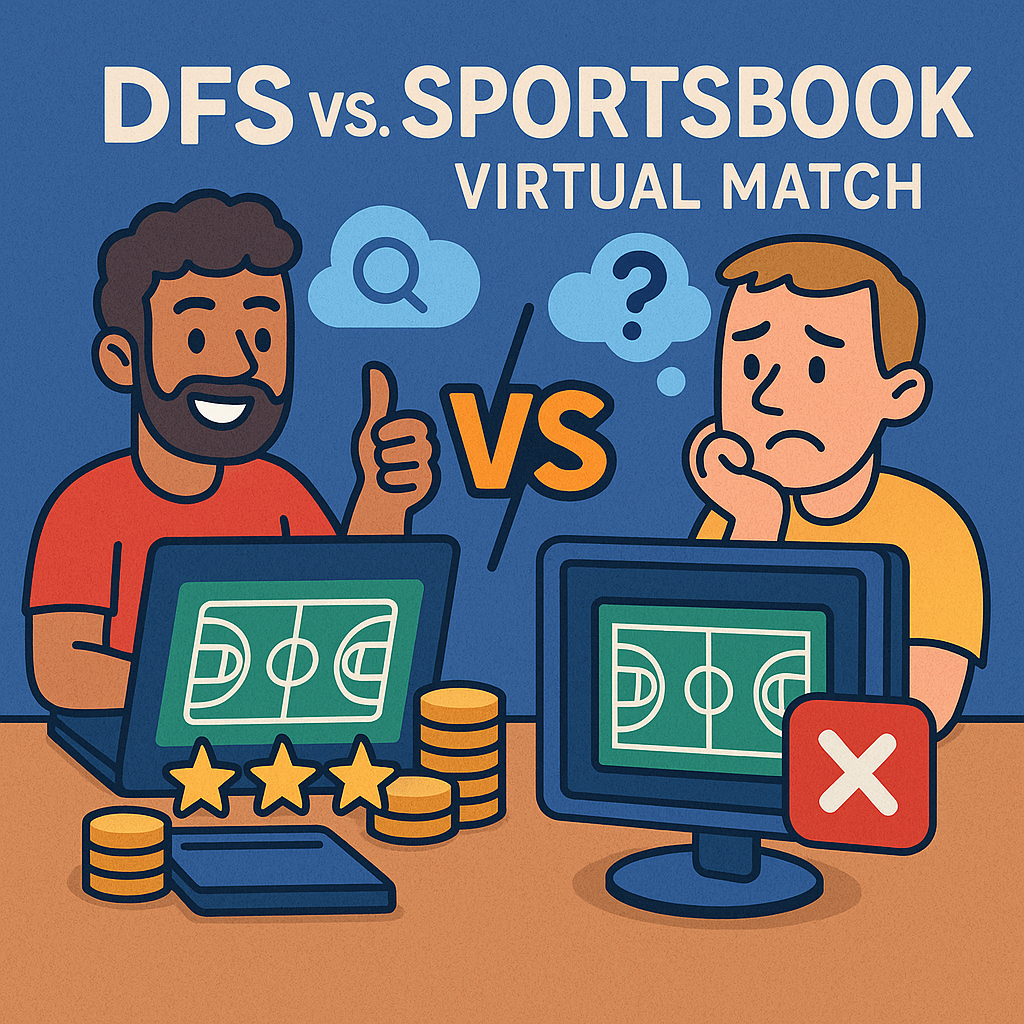
A deep analytical report on why DFS gameplay stays transparent and unbiased, no matter the match source
In traditional sportsbooks, virtual sports have always been controversial.
Players often distrust simulations generated by the bookmaker, fearing hidden manipulation.
But in Daily Fantasy Sports (DFS), the entire fairness model is fundamentally different — so different that even if a DFS contest used virtual match data, the integrity of the game would remain intact.
This article breaks down why sportsbook virtual matches are distrusted, why DFS gameplay cannot be influenced the same way, and why player-versus-player (P2P) fantasy formats are inherently fair, regardless of whether the underlying match is real or simulated.
1. Why Virtual Matches Are Distrusted in Traditional Sportsbooks
Before understanding DFS fairness, we first need to understand why virtual matches historically failed inside sportsbooks.
A. Sportsbook bets are “outcome bets” — not performance-based
In sportsbook betting, wagers focus on:
- Which team wins
- Final scores
- Over/under totals
- Goal/point spreads
This means the entire bet outcome relies on a single, binary result.
B. Sportsbooks are the counterparty
When betting on a sportsbook:
You are betting against the house.
This immediately creates a conflict of interest:
- The house loses money when players win
- The house profits when players lose
C. Virtual matches are generated by the sportsbook
This is where player distrust peaks.
Sportsbook virtual matches are:
- Simulated
- Generated by software
- Controlled by the operator
Because the house has both:
- The incentive (they lose if you win), and
- The ability (they control the simulation engine)
Players naturally suspect manipulation.
Even if the system is fair, perception is already damaged.
2. Why DFS Is Different: Virtual or Real Game, Fairness Remains the Same
DFS does not rely on the match outcome.
DFS relies on player-by-player performance output and strategic lineup construction.
And this changes everything.
Let’s break down the reasons.
3. DFS Is P2P — Not Player vs. House
DFS = Player vs Player
In DFS, you are not betting against the game operator.
Instead:
All players compete against each other, and the platform simply collects an entry fee commission.
This means:
- The DFS operator does not win more when players lose
- The DFS operator does not lose money when players win
Unlike sportsbooks, the operator has zero financial motivation to influence results — real or virtual.
The operator’s revenue is fixed
Whether you:
- Finish 1st
- Finish last
- Or don’t cash at all
The platform’s take (rake/commission) does not change.
No financial incentive = no reason to manipulate anything.
4. DFS Relies on Player Statistics, Not Match Outcomes
Even if a DFS contest used a virtual match, the platform still cannot influence the winning players, because DFS is not outcome-based.
DFS scoring is built on:
- Points
- Rebounds
- Assists
- Steals
- Blocks
- Fantasy-specific scoring rules
Changing the outcome of a match (e.g., Team A wins instead of Team B) does not translate into meaningful control, because DFS players win based on individual statistical outputs, not final results.
5. The Mathematical Shield: Combinatorial DFS Lineups Make Manipulation Impossible
This is the most important, under-discussed point.
Even if a platform wanted to tilt outcomes (they don’t), they mathematically cannot, because DFS lineups have astronomical combinatorial variety.
Example: Daily Fantasy’s Standard DFS Format
A lineup includes:
- 1 PG
- 1 SG
- 1 SF
- 1 PF
- 1 C
- 3 FLEX
- Plus Captain and Vice-Captain multipliers
Let’s assume a modest player pool of only 30 players available for a contest.
(This is extremely conservative — many DFS contests have 150–300+ players.)
Step 1: Position Constraints
Even with constraints, valid combinations easily reach trillions.
Step 2: Captain and Vice-Captain Multipliers
The moment you include multipliers:
- Captain (2×)
- Vice-Captain (1.5×)
The number of unique scoring outcomes explodes, because:
- Player A as Captain ≠ Player A as Vice-Captain
- Player A as Captain + Player B as VC ≠ Player B as Captain + Player A as VC
- Each lineup yields drastically different fantasy totals
Step 3: Total Combinatorial Space
Even simplified, DFS lineup combinations exceed:
10^12 to 10^18 unique lineup possibilities
(1 trillion to 1 quintillion)
For larger pools?
10^30 to 10^40+ lineup variations
(numbers large enough to exceed the number of stars in the galaxy)
Why does this matter?
Because it means:
- No operator can target a specific user
- No operator can “rig” individual player stats in a way that benefits one lineup without benefiting countless others
- No simulated output can predetermine which lineup wins
DFS outcomes are mathematically decentralized.
The sheer combinatorial variety makes manipulation pointless and ineffective.
6. Virtual Matches Do Not Create Operator Incentive — So There Is No Conflict of Interest
In Daily Fantasy Sports, the fairness of the game does not depend on whether the match is real or virtual.
The key reason is simple: DFS operators have zero financial incentive to influence outcomes.
Here’s the comparison rewritten in Webflow-friendly bullet format:
🟥 Traditional Sportsbook (Real Matches)
- Players bet against the house
- The operator loses money when players win
- The operator profits when players lose
- This creates a direct conflict of interest
- Result: Players naturally suspect manipulation
🟧 Sportsbook Virtual Matches (Simulated Games)
- Matches are generated by the sportsbook
- The operator controls the simulation engine
- The house has full incentive AND ability to influence results
- Players often distrust the system, even if it’s fair
- The perception of “rigging” is unavoidable
🟩 Daily Fantasy Sports (Real or Virtual Match Data)
- DFS is P2P (player vs. player)
- The operator only earns a fixed commission (rake)
- Whether players win or lose, the operator’s earnings do not change
- There is zero incentive for the operator to adjust or manipulate results
- Virtual match or real match — fairness remains exactly the same
Key Takeaway
Sportsbooks have motivation to alter outcomes. DFS operators do not.
This structural difference removes the conflict of interest entirely, ensuring that DFS remains fair no matter where the match data comes from.
7. Even If the Match Is Virtual, DFS Fairness Is Unchanged
DFS fairness does not depend on:
- real match vs virtual match
- real athletes vs simulated athletes
- real outcomes vs simulation outcomes
DFS fairness depends on:
- P2P competition
- Transparent scoring rules
- Independent player statistics
- No operator exposure
- No house-vs-player conflict
As long as the operator does not benefit from any player winning or losing, the fairness model is intact.
8. Why DFS Players Should Not Fear “Virtual Match Bias”
Reason 1: No house-edge bias
DFS is not house-vs-player betting.
Reason 2: Lineup variety protects fairness
You cannot predict or manipulate winner outcomes in a space with trillions of lineup permutations.
Reason 3: Player performance > match outcome
Even if the match result changes:
- A player can still score 32 points
- Another can still grab 15 rebounds
- Another can still block 4 shots
Match outcomes don’t matter — player stats do.
Reason 4: Operator neutrality
Rake is fixed.
Win or lose, the operator earns the same.
Thus, manipulation is pointless.
Reason 5: Transparent scoring formulas
DFS scoring is mathematical, not subjective.
Conclusion: DFS Fairness Is Protected by Design — Real or Virtual
Players distrust virtual matches in traditional sportsbooks because the house:
- generates the match
- controls the outcome
- has financial motivation to manipulate results
But DFS is fundamentally different:
- It is P2P, not house-vs-player
- The operator has no incentive to influence outcomes
- The combinatorial explosion of lineups makes manipulation useless
- Player statistics — not match results — determine winners
- Operator profit is fixed via entry fee rake
Whether the underlying match is real or virtual, DFS fairness remains intact because the game model itself removes conflict of interest.
DFS is fair not because of what match you use —
but because of how the game is structured.